RLC Resonant Circuits: Damping Factors, Q-Factor, and Bandwidth Filtering
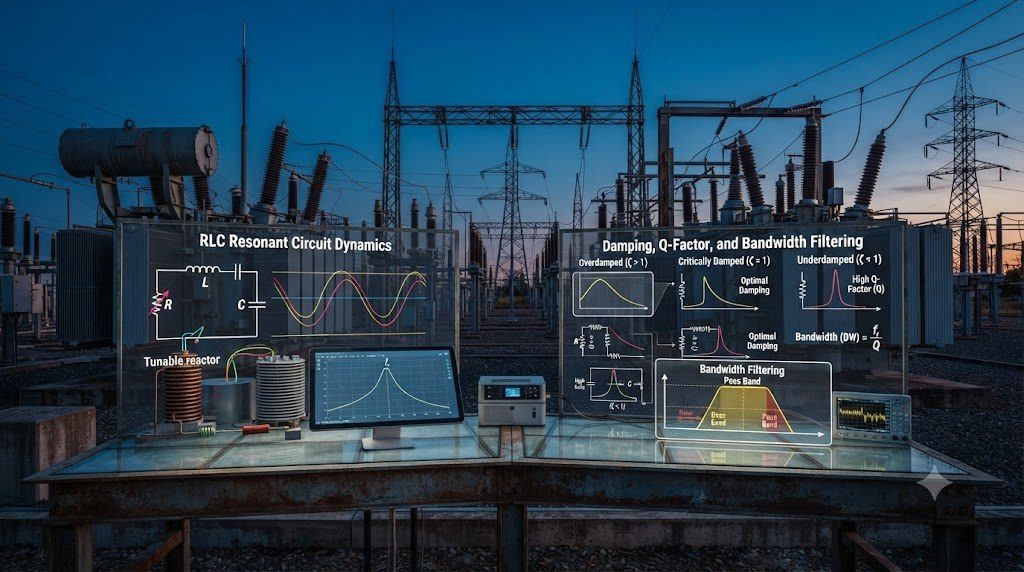
In electronic engineering and telecommunications, few network configurations possess greater utility and mathematical elegance than the Resonant RLC Circuit. Comprising a resistor (R), inductor (L), and capacitor (C) connected in series or parallel, an RLC circuit functions as a second-order linear dynamic system capable of natural electrical oscillation. The continuous, cyclical exchange of energy between … Read more
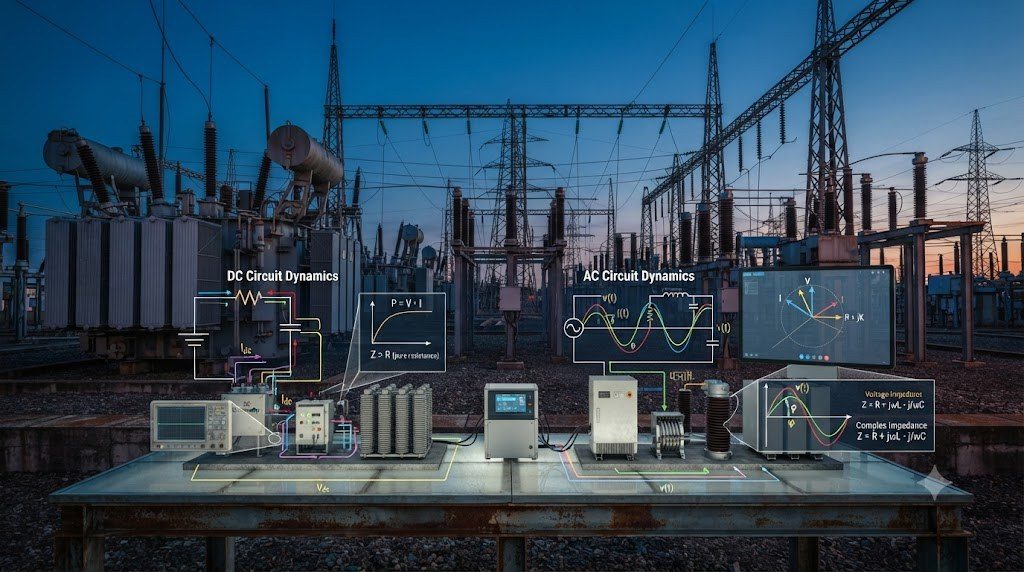
AC vs. DC Circuit Dynamics: Phasors, Complex Impedance, and Phase Angles

The historical and technological divide between Direct Current (DC) and Alternating Current (AC) defines the modern electrical landscape. Originating in the fierce nineteenth-century “War of Currents” between Thomas Edison’s low-voltage DC grids and Nikola Tesla’s transformer-coupled polyphase AC systems, the physical divergence between steady-state unidirectional electron flow and sinusoidal oscillatory electron motion underpins everything from … Read more

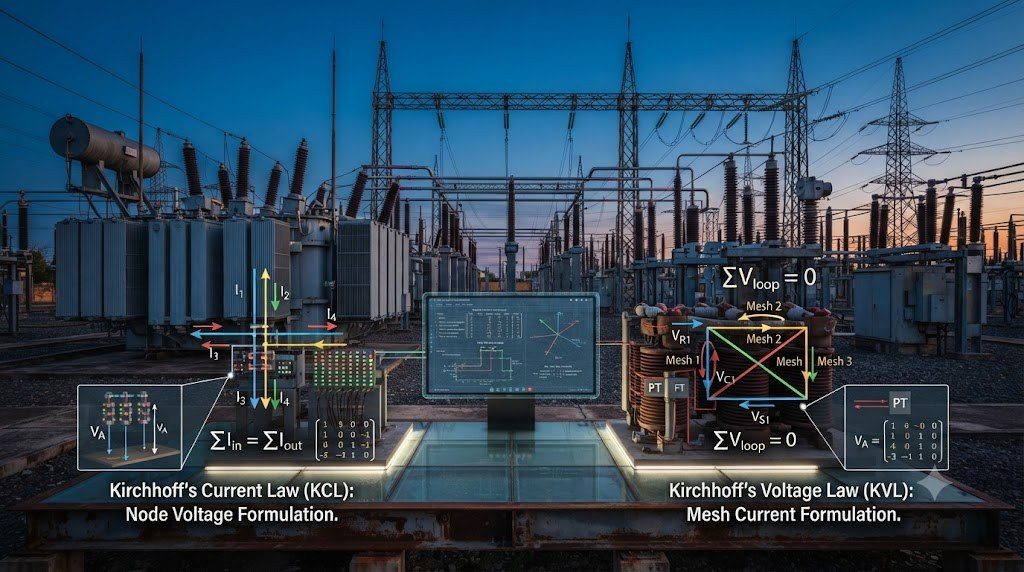
Kirchhoff’s Laws: Node Voltage (KCL) and Mesh Current (KVL) Formulations

At the bedrock of all lumped-parameter electrical circuit analysis lie two fundamental physical laws formulated in 1845 by German physicist Gustav Kirchhoff: Kirchhoff’s Current Law (KCL) and Kirchhoff’s Voltage Law (KVL). While Maxwell’s electromagnetic field equations describe electromagnetic wave propagation across continuous space, Kirchhoff’s laws translate these spatial vector relationships into elegant, solvable algebraic equations … Read more

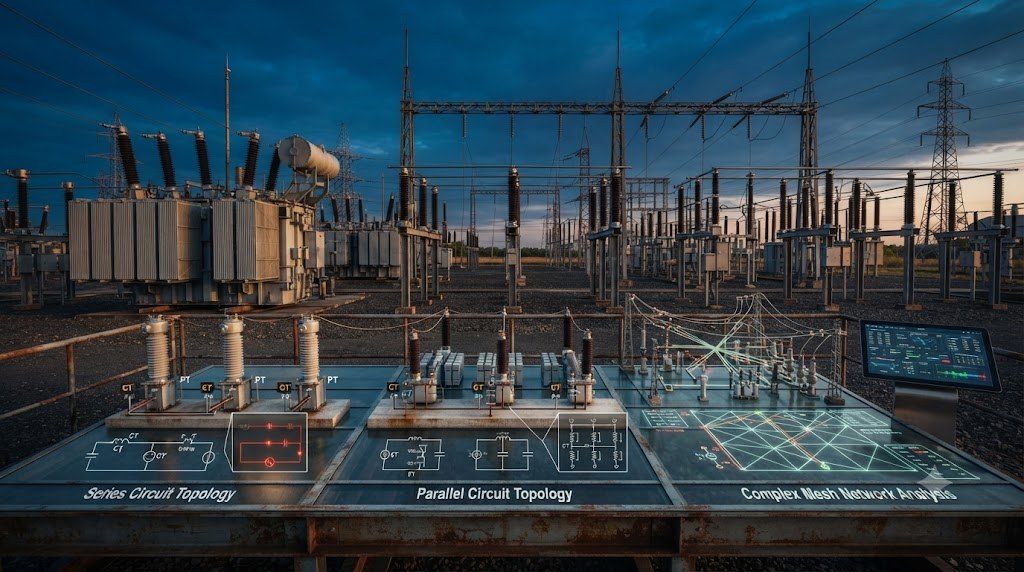
Circuit Topologies: Series, Parallel, and Complex Mesh Network Analysis

In the foundational physics and engineering of electrical systems, an electrical circuit is a closed conducting path through which electric charges flow under the influence of potential differences. Whether analyzing a microscopic integrated circuit (IC) containing billions of sub-micron MOSFET transistors or a continental high-voltage electrical grid transmitting gigawatts of alternating current, the underlying mathematical … Read more